Dun Bharabhat is one of around 600 brochs in Scotland (a very impressive one not far from our B&B is Carloway Broch).
The word broch, originating from the Old Norse borg and the German burg which means castle or fortress, describes a number of stone roundhouses that were constructed during the period from 300BC to 400AD.
Also known as a dùn – as in Dun Bharabhat on our own Great Bernera – it’s not clear whether their purpose was primarily as a fortress, as a place of refuge for people and animals, or as a sign of wealth, status and prestige.
Unlike Carloway Broch, which was built on top of a hill overlooking the sea, Dun Bharabhat stands on a small oval-shaped islet in a freshwater loch, lending credence to the idea that its primary function was defensive.
The broch covers the whole of the islet and is approximately 12m long by 9m wide. The north wall is the most intact, at around 3m high and one metre thick, and there are remnants of an entrance on the east side. Excavations in the 1980s revealed three main galleries, a hearth, items of pottery and some animal bones and teeth.
The lichen-covered north wall viewed from the causeway
The double north wall with a passageway between
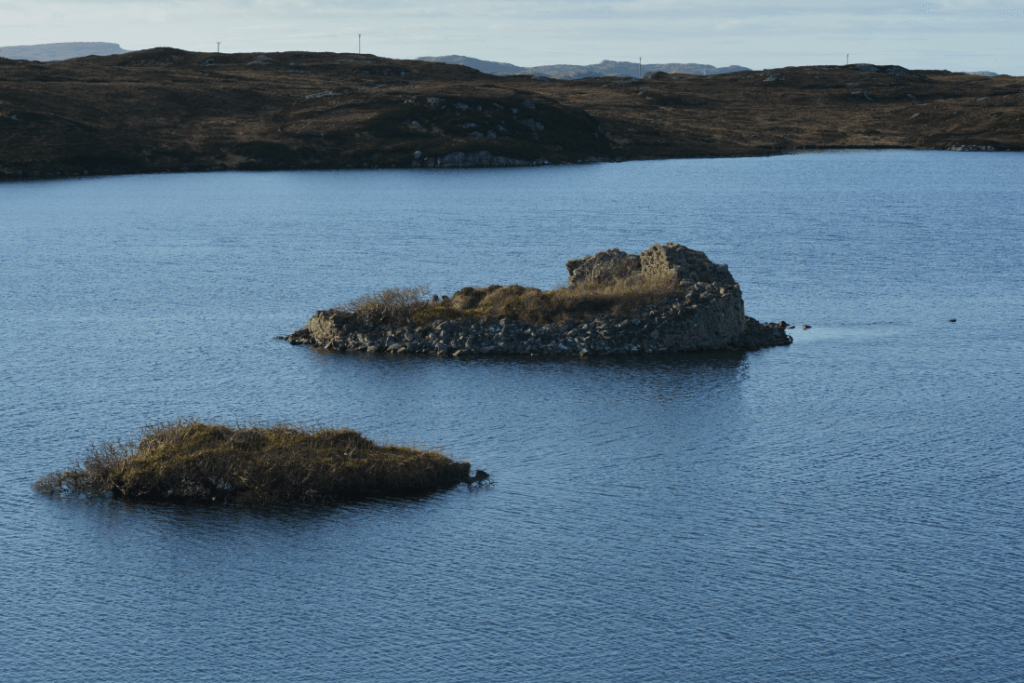
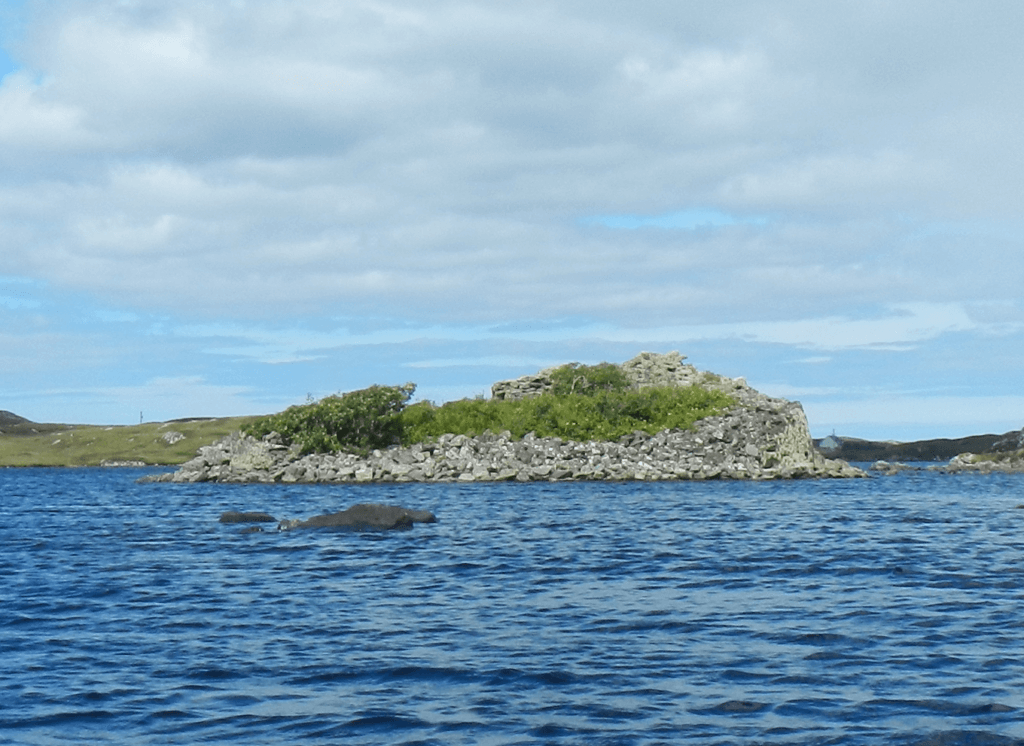
The loch is not tidal, but in drier months its water level can sink low enough to uncover a 30m-long causeway, allowing access to the dun without wet feet. When the loch is full, only the tops of a few stones can be seen.
When the loch is full, as in this photo taken in February 2023, the causeway is submerged
This photo, taken in August 2023, shows how much of the causeway can appear above the water line in summer
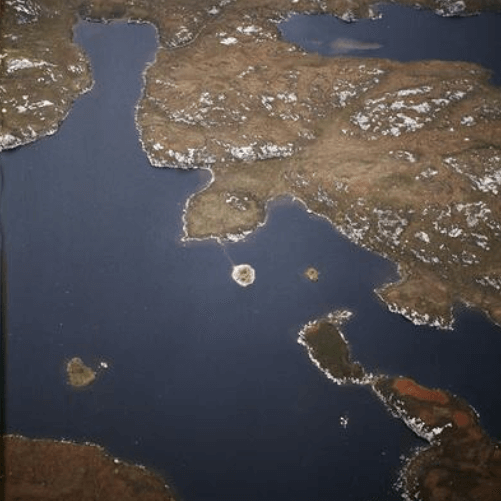
This aerial view shows the circular structure of the dun and the causeway leading to it Source: https://canmore.org.uk/site/4089/lewis-great-bernera-loch-baravat-dun-baravat
Dun Bharabhat is not far from our B&B. It can be reached by parking at the cattle grid on the Breacleit road and walking westwards for approx. 15 minutes.
This map shows the location of Dun Bharabhat in relation to our B&B
A signpost next to the road points to the track
Wooden posts mark the way over uneven ground which can be boggy at times – sturdy, waterproof shoes are recommended
The views around the dun encompass a typical Lewis landscape
What a really wonderful part of the world. I doubt we shall make it in 2023 unless, maybe, the autumn. Otherwise next year. How long should we spend to get a real taste of the area?
Oh, you can spend as long as you want, Duncan! You’ll probably be able to visit most of the main ‘tourist’ sights within a week but there are many other nooks and crannies that we’re only discovering after four years living here 😉
Click on ‘Things to do’ in the navigation bar for more information.
Great photos! I have visited Great Bernera in May to see the archaeological sites, Dun Bharabhat was wonderful, so were the standing stones, remains of Dun Barraglom and the Bernera Museum in Breacleit. Just a small correction – the photos are of Dun Bharabhat on Great Bernera, while the aerial photograph from Canmore is of another site of the same name at Kneep on Lewis. There are two sites with the name Dun Bharabhat: https://canmore.org.uk/site/4020/lewis-dun-bharabhat https://canmore.org.uk/site/4089/lewis-great-bernera-loch-baravat-dun-baravat
Thank you Broch Hunter (what a great name!) for the correction. I’ve made the amendment so that the correct aerial image is showing. I did think there was something ‘not quite right’ about the first image but assumed it was perhaps an old photo taken when the dun was more intact. Now I know the difference! I hope you enjoyed your visit to Great Bernera 😊
We use cookies to ensure that we give you the best experience on our website. If you continue to use this site we will assume that you are happy with it.





4 thoughts on “Dun Bharabhat”
What a really wonderful part of the world. I doubt we shall make it in 2023 unless, maybe, the autumn. Otherwise next year. How long should we spend to get a real taste of the area?
Oh, you can spend as long as you want, Duncan! You’ll probably be able to visit most of the main ‘tourist’ sights within a week but there are many other nooks and crannies that we’re only discovering after four years living here 😉
Click on ‘Things to do’ in the navigation bar for more information.
Great photos! I have visited Great Bernera in May to see the archaeological sites, Dun Bharabhat was wonderful, so were the standing stones, remains of Dun Barraglom and the Bernera Museum in Breacleit. Just a small correction – the photos are of Dun Bharabhat on Great Bernera, while the aerial photograph from Canmore is of another site of the same name at Kneep on Lewis. There are two sites with the name Dun Bharabhat:
https://canmore.org.uk/site/4020/lewis-dun-bharabhat
https://canmore.org.uk/site/4089/lewis-great-bernera-loch-baravat-dun-baravat
Thank you Broch Hunter (what a great name!) for the correction. I’ve made the amendment so that the correct aerial image is showing. I did think there was something ‘not quite right’ about the first image but assumed it was perhaps an old photo taken when the dun was more intact. Now I know the difference!
I hope you enjoyed your visit to Great Bernera 😊